
Curly Hair Care Guide | Styling Methods & Foundations
If you have wavy, curly, coily or tight-textured hair, understanding how your hair behaves is just as important as the products you use.
This page is a growing education space, bringing together foundational curl principles, technique guidance and practical insights drawn from real-world practice behind the chair by proud owner and internationally-trained curl specialist, Donna (aka. The Curl Next Door).
Our strong belief is that your natural texture is beautiful, products support the goals and styling options inherent in your hair, and method activates the process.
Curls 101 — The Foundations
Healthy curls are supported by compatible, water-soluble formulations, gentle and consistent handling, and an understanding of how our natural hair fibre behaves.
But healthy curls aren't supported by haircare products alone. Socially, they're also supported by having people around us who understand both the challenges and the natural beauty of textured hair - people who help us learn about it, work with it and value it as it naturally grows.
Curly hair isn't a trend to dip in and out of, although fashion will periodically decide to emphasise textured hair, only to then move its attention elsewhere two years later.
Your natural texture, hormonal and other biological changes aside, doesn't work that way. It has a constancy that largely ignores what happens to be considered 'in' one year and 'out' the next.
It is a structural pattern growing from your scalp. Whether that pattern appears right from the roots or further down the hair length, whether it forms a soft wave, a tight coil, or anything in between, it belongs uniquely to you. It is like a fingerprint.
It isn't a trend you're wearing. It's part of you.
Understanding your strand width, density, damage level, and lifestyle will influence how your curls respond to products and techniques. Fine strands behave differently from coarse strands. High density behaves differently from low density. And, just to keep us on our curly toes, hormonal shifts, environmental exposure and mechanical habits all make a difference to how your hair fibres present over the course of your life.
Therefore, product alone doesn't determine outcome. Technique alone doesn't determine outcome.
Structure, formulation and method work together.
When you begin observing your hair as a fibre — rather than as a “curl type” — decision-making becomes clearer.
Curls are not inherently dry, frizzy or difficult. They are responsive.
When supported appropriately, they organise themselves. When overloaded, stretched or coated, they disengage.
This education space will continue to expand over time to explore strand width, density, damage, hormonal changes and foundational curl principles in greater depth.
For now, begin here:
Work with the fibre in front of you. Support its structure. Choose formulations and methods that respect its movement.
That is the foundation.
Why Method Matters
Choosing to embrace your natural curls, waves, kinks or coils is a powerful first step.
Moving away from harsh detergents and heavy coating ingredients supports hair health — but products are only one part of the equation.
How you cleanse, detangle, style and dry your hair directly affects both fibre integrity and the appearance of your curls.
Curl professionals consistently agree: method matters just as much as formulation.
Methods That Affect Hair Health
Certain habits contribute to cumulative damage over time.
These include excessive heat styling, frequent use of straighteners or curling tongs, chemical straightening or colouring, mechanical tension from tight hairstyles, aggressive brushing, and rough towel-drying. Heat tools alter the internal structure of the hair. Tight elastics create stress points along the strand. Vigorous brushing disrupts natural curl groupings and weakens fibre alignment.
The extent to which you use these methods is always your choice — but understanding their impact allows you to make informed decisions.
Curl-supportive methods tend to be gentler:
Gentle cleansing with a sulphate-free cleanser or co-washing where appropriate.
Finger detangling with conditioner to reduce breakage.
Blotting or scrunching excess water with a soft cotton t-shirt rather than rubbing with a bath towel.
Air-drying, diffusing, or hooded drying on moderate heat.
Choosing low-tension styles where possible.
These choices accumulate over time.
Methods That Shape Curl Appearance
Even when hair is healthy, technique determines whether curls look soft and fluffy, or defined and structured.
On one day, hair can be washed and dried with minimal styling intervention and appear loose and airy. On another, deliberate clumping, product layering and controlled drying can create defined, hydrated-looking curls.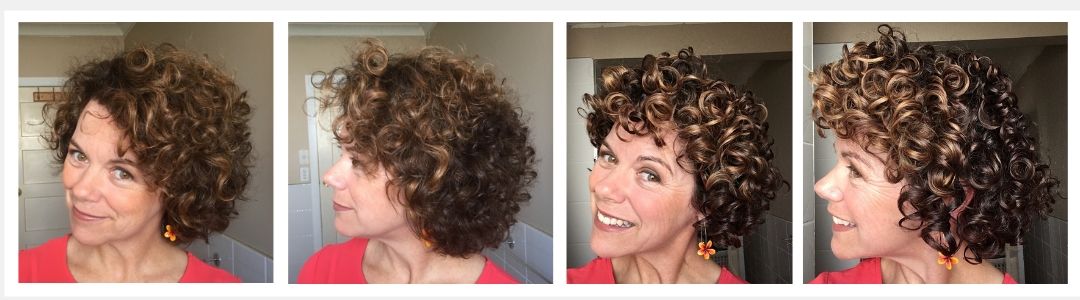
Same hair. Different method.
This gives you options.
Having naturally curly hair does not mean accepting a life sentence of frizz if that is not your preference. Some frizz is natural — but much of what we interpret as “unruly” is often technique-related. Also lovelies, frizz is a very normal part of healthy natural texture, so it is something worth making peace with as you embark on your natural texture journey.
Foundational Styling Principles
A few core principles apply across most wavy and curly textures.
Applying product to soaking-wet hair encourages stronger clumping and definition. Removing excess water before applying product creates a more dispersed, softer result.
Water is a powerful styling tool. Water plus product equals definition. How much water you use influences the outcome.
“As it looks wet, so it will look dry.”
If curls are webbed together when wet, they will dry that way. If they are separated when wet, they will remain separated when dry. Creating a light product cast — often from a gel or styling base — helps hold curl structure during drying. Once fully dry, that cast can be softened to your preferred level of movement.
Touching the hair while drying increases separation and softness. Leaving it undisturbed encourages stronger definition.
These variables allow you to adjust your result based on your goals for the day.
Where to Go Next
Understanding method allows you to work with your texture rather than against it.
If you'd like to understand how ingredients work inside curly hair products, you can explore our Curly Hair Ingredient Guide.
If you would like deeper guidance tailored to your specific strand width, density and curl goals, explore further education at The Curl Next Door.
If you are ready to experiment with curl-friendly products and tools, browse our curated collections within Curls Naturally.
This page will continue to evolve as more foundational curl education is added.